

Mikroskopia bliskiego pola i wzmocnienie syganału oddziaływaniem z sondą
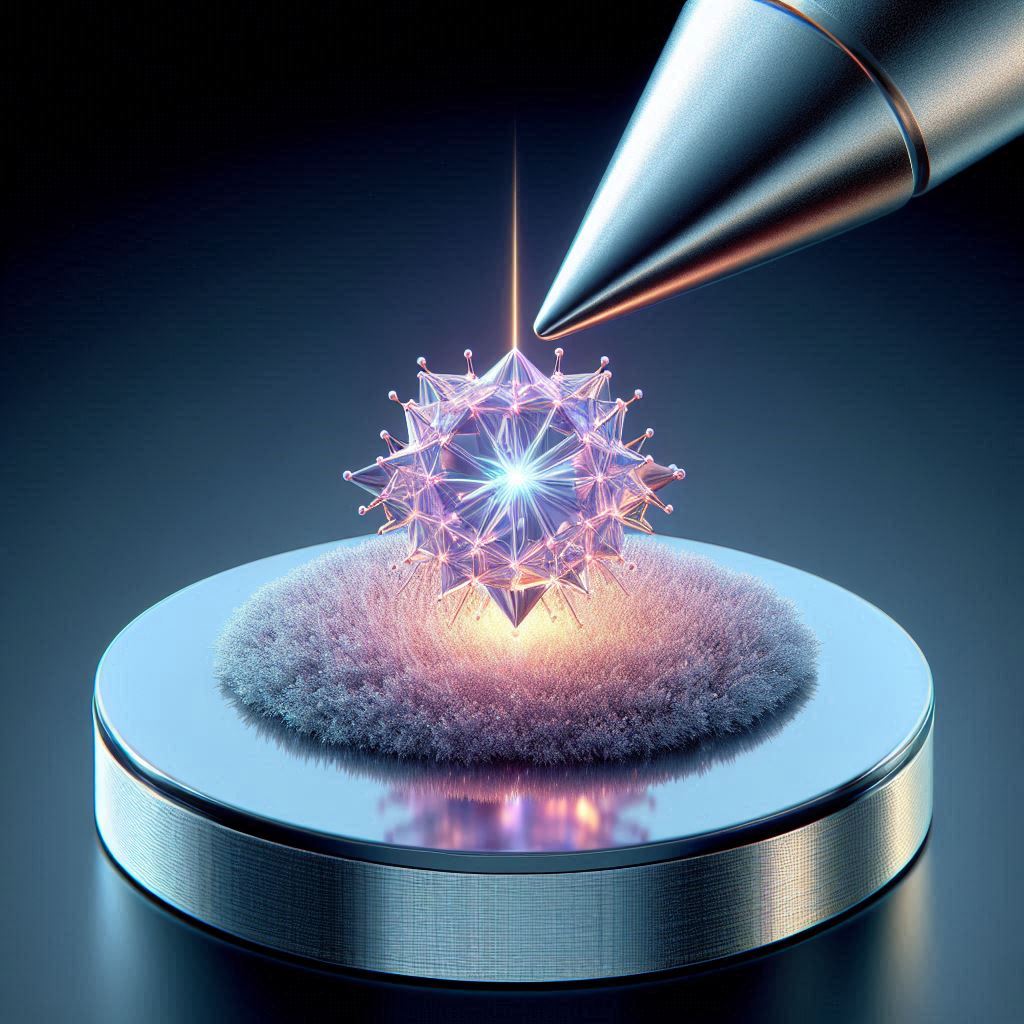
The technique we use relies on the locally enhanced optical fields close to a laser illuminated, sharp metal tip. The sample is raster scanned below the tip which can act as a highly confined excitation source providing a considerable signal enhancement and spectroscopic images at very high spatial resolution.
Our experimental setup is based on an inverted optical microscope with an x, y scan stage for raster scanning a transparent sample. The excitation is provided by a HeNe laser operating at 632.8 nm that is reflected by a dichroic beam splitter and focused by a high numerical aperture objective (1.4 NA) on the sample surface.
A sharp gold tip is positioned near the focus of the beam and maintained above the sample surface at a distance of ~1-2 nm by means of a sensitive shear-force feedback mechanism. The gold tips with a radius of 10-15 nm are produced by electrochemical etching.
Both Raman scattered light and luminescence are collected with the same objective, transmitted by the beam splitter and separated by a long pass filter. The signal is then detected either by a combination of a spectrograph and a charged coupled device (CCD) or by avalanche photodiodes (APDs).
Tip-enhanced near-field microscopy allows for optical imaging with a spatial resolution below 20 nm and spectroscopy on a nanometer scale.